ABOUT SHERPA Institute
GUIDING YOU FROM innovative IDEAS to BADASS Breakthroughs
WE AREN’T FOR EVERYONE
When we claim to be BADASS, what do we mean? This term might offend the reader straight away. That’s okay. We are not a fit for everyone. Our diverse, worldwide viewpoints bring a level of intellectual humility and curiosity that combine into a BADASS world-view; we are not provincial, bending to polite norms. We are a global nonprofit, headquartered in North Alabama, USA, with key staff officed in Decatur and Huntsville Alabama, as well as Tampa, Florida, throughout the United States and Santiago, Chile. Support contributors are also located in locations as dispersed as India, Canada, Turkey and Tunisia.
SHERPA Institute has over 10 years of experience providing organizations fully understand the complexities of their internal and external stakeholders, up and down their value chain, choose select initiatives, create a project pipeline and decide what to prioritize. We carefully evaluate and summarize the experience of all project stakeholders, including team members and recipients of the improvements. Through our approach, we have successfully guided organizations to grow existing business through innovative breakthroughs, increase employee engagement, encourage intra-industry collaborations and engage in local communities. We guide teams through the implementation of multiple, interconnected projects, that feed up into initiatives, walking hand in hand in order to make the BADASS breakthroughs real. We don’t just show PowerPoint slides, hand over some templates and walk away. Our team has a combined 100+ years of real-world expertise, and is proud to wear the badge of BADASS.
What It Means to Be a Badass | Psychology Today
A 2010 Psychology Today article on the term holds true even more today. Dr. Jim Taylor leads with “Disclaimer: I apologize in advance for using the word badass. I realize that it might offend some people. But, right or wrong, it is now a mostly accepted part of our vocabulary, even listed in traditional on-line dictionaries. If you find the word objectionable, please focus on the message rather than on the (for some) inappropriateness of the word.”
Dr. Taylor goes on to explain, “A real badass is driven by values such as responsibility, justice, honor, courage, compassion, humility, integrity, and selflessness, which pretty much disqualifies most every self-proclaimed badass out there.
… A badass does what needs to be done, no matter how difficult it is, without complaint or need for fanfare. A badass doesn't take the path of least resistance.
A badass is someone who stands up for the weak and oppressed, speaks the truth, and calls out those who lie, cheat, and steal. A badass is someone who takes a "hit for the team," meaning puts others' needs ahead of their own, [like] a CEO who cares more about his employees than his P&L statement during an economic crisis.”
WHO’S A FIT?
WHO Seeks Guidance from innovative IDEAS to BADASS Breakthroughs?
Organizations engage us because they want to hear the truth as seen from outside. SHERPA Institute tells it as we see it. We are the voice of truth in a room that likely has opinions or viewpoints kept hushed. A BADASS can be disruptive, when an organization has been keenly focused on delivering polished messaging to stakeholders, from shareholders to the general public. We tear down this messaging and collaboratively redesign the future path, for an authentic message to the world about an organizations renewed mission, vision, core values and actions to backup these statements.
As we’ve asserted throughout this site, we have successfully guided organizations to grow existing business through innovative breakthroughs, increase employee engagement, encourage intra-industry collaborations and engage in local communities. We guide teams through the implementation of multiple, interconnected projects, that feed up into initiatives, walking hand in hand in order to make the BADASS breakthroughs real. We don’t just show PowerPoint slides, hand over some templates and walk away. SHERPA Institute does provide Project Leader Training, after a considerable period of the Institute leading projects. During that time, the most promising candidates for Project Leader Training are identified and many begin to learn the process, by participating in SHERPA-led projects. Organizations that are the best fit are willing to trust the process; whether they are already using a formalized method or not. The CISR Methodology is proven, and organizations open to following the approach and commit the time to initiatives, each with multiple, diverse projects, will reap rewards beyond expectations.
Our Methodology is Continual Improvement for Social Responsibility – CISR (sounds like scissor). This is an evolution of Lean Six Sigma, with a focus on bringing the International Standard for Social Responsibility – ISO 26000 – to life in every nook and cranny of an organization. Our Method is a 6-Phase approach, called SOFAIR. We practice a higher-level evolution from our LSS roots of the 5-Phase DMAIC Method, which results, not only in improved efficiency and quality, but also in CULTURE CHANGE. Our bookends of "S" and "R" are the key differentiators.
The LSS approach begins with Problem Definition (D), which includes tools that don't necessarily account for the deep dive into, and continual revisiting throughout the process, of Stakeholders. There are many other differences, including adapted tools, and the inclusion TRIZ (Russian acronym for Theory of Inventive Problem Solving), but the ending of SOFAIR stands out. Rather than the DMAIC Control Plan, we end with "R" - Report and Repeat. Stakeholders receive communications about a project's solution and implentation plan, while the team is already starting on the next project. Artifacts from previous projects are used, accelerating the process and creating a virtuous upward spiraling vortex of social responsibility performance improvement and CULTURE CHANGE.
WHERE DO WE GO FROM HERE AND HOW DO WE GET STARTED?
It all begins with a conversation, to determine whether SHERPA Institute is a fit. We cover the details of each phase within the launch engagement and answer any questions. The schematic shown here is flexible and we can compress lengthen time for any phase or steps.
Each phase takes about six months, with the potential to accelerate or lengthen timing, depending on allocation of the organization’s stakeholders, business cycles and objectives.
We begin by explore your current state, levels of urgency on various topics, what is working and what areas need immediate attention. If we mutually decide to take the journey together, our Next Steps Outline, provided below in brief, is sent for your review, followed by a Kick-Start Engagement Agreement.
We then get started on leading positive Social Responsibility Performance Improvement for elevated culture, higher efficiency, increased innovation, better risk management, and other hallmarks of an unbeatable competitive advantage.
Our Kick-Start 1-2-3 Strategy approach might seem simple, but the results will permeate throughout and beyond your organization. Into your community, within your supply chain, and with your customers.
Among the powerful benefits of emerging CULTURE CHANGE you will:
1. Understand actual problems and/or risks related to Stakeholder and Social Responsibility RISKS – BECOME PROACTIVE!
2. Develop measurable innovative solutions through teamwork that align with organizational objectives.
3. Identify next steps and future projects, planning for future Project Leadership.
THREE SIMPLE PHASES OF ORGANIZATIONAL ENGAGMENT PRIOR TO PROJECT LEADER TRAINING
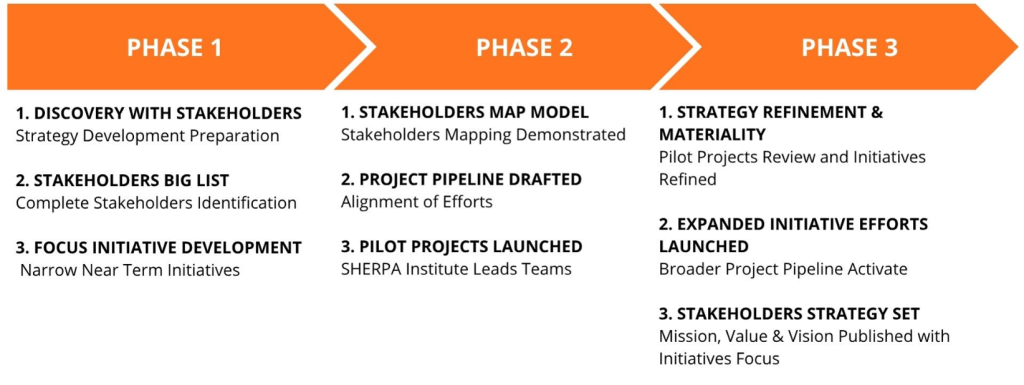
AH NOTE: I THINK WE SHOULD REVISE TIMELINE TO HAVE PHASE 3 STEP 3 AT END OF PHASE 2.
THE REASON IS THAT WE ARE GETTING READY TO LAUNCH AN OFFERING, IN WHICH OUR PROMISE IS TO HAVE SOMETHING REPORTABLE BY Q1 2027.
PHASE 2 STEPS 2 AND 3 COULD BE COMBINED.
PHASE 3 STEP 3 COULD BE CHANGED TO:
IDENTIFY POTENTIAL PROJECT LEADER TRAINEES
Senior Leadership and SHERPA review completed projects and identify most promising trainees, based on participation, leadership skills developed, and enthusiasm for following the process.